

The APOLLO/LUNAR studies
UP TO

IOP REDUCTIONfrom baseline1
Mean IOP reduction ranged from 7.5 mmHg to 9.1 mmHg in 9 time points through Month 3.1,2*
>30%
MEAN DIURNAL IOP REDUCTION
across all tested time points3
>30%
MEAN DIURNAL IOP REDUCTION
across all tested time points3
At Month 3, the mean diurnal IOP reduction was 32% in both studies.†


Baseline mean diurnal IOP was 26.7 mmHg and 26.5 mmHg in APOLLO and 26.6 mmHg and 26.4 mmHg in LUNAR for VYZULTA and timolol 0.5%, respectively.1,2
In a pooled analysis, mean IOP was lower in VYZULTA patients compared with timolol 0.5% patients at Month 3 and stayed low through Month 12.4


VYZULTA provided consistent IOP lowering over a 12-month period.4
Patients who switched from timolol 0.5% to VYZULTA at Month 3 experienced additional IOP reductions.4
Most VYZULTA patients exceeded AAO IOP reduction targets of 20% to 30% from baseline5,6
Post Hoc Responder Analysis of APOLLO/LUNAR Pooled Data (N=562)6

Baseline mean diurnal IOP was 26.7 mmHg and 26.5 mmHg in APOLLO and 26.6 mmHg and 26.4 mmHg in LUNAR for VYZULTA and timolol 0.5%, respectively.1,2
The VOYAGER study
34.6%
mean IOP reduction from baseline7


29.8%
mean IOP reduction from baseline7
(P=0.005)
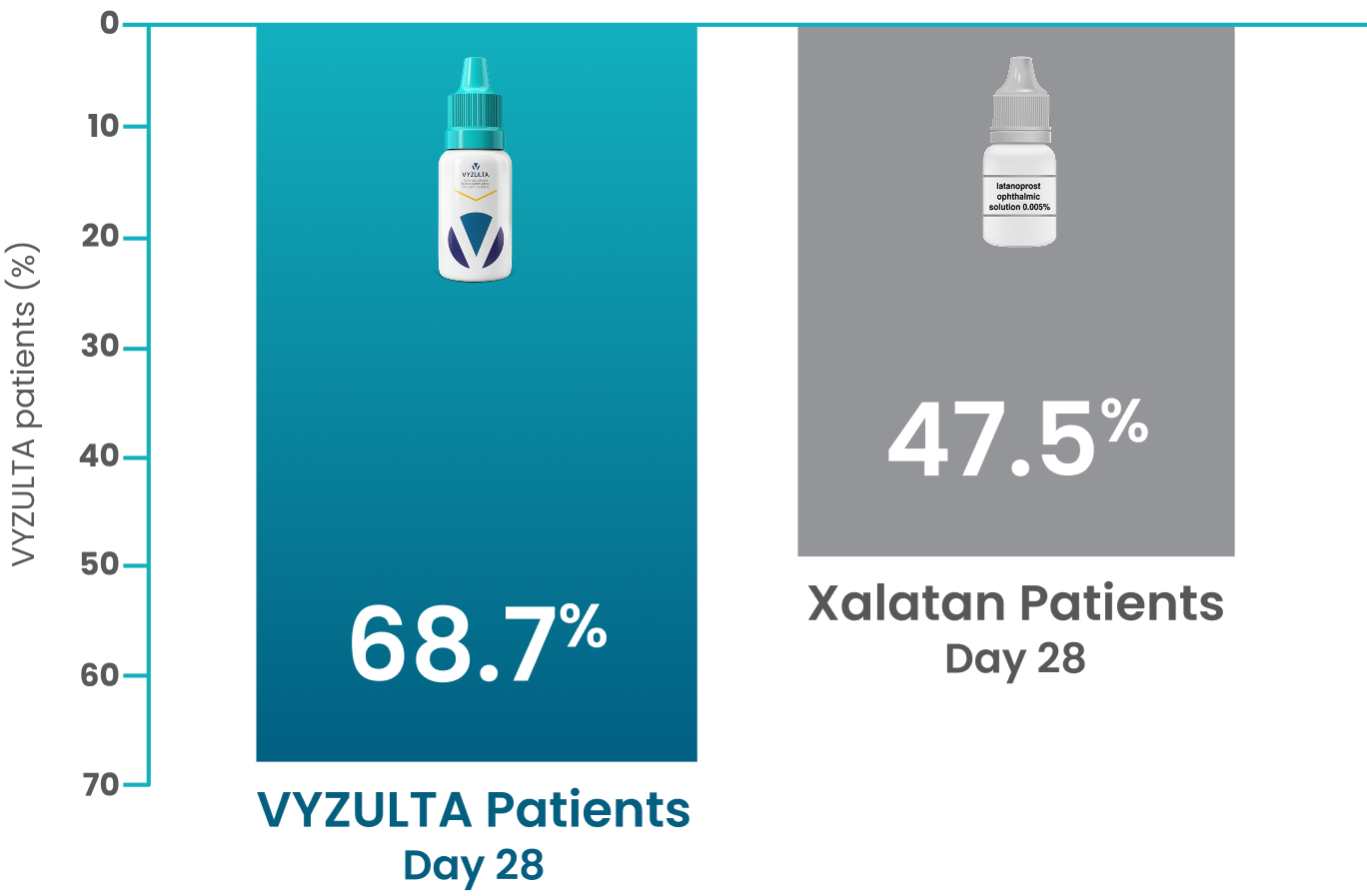
Baseline mean diurnal IOP was 26.01 mmHg and 26.15 mmHg for VYZULTA (n=83) and Xalatan (n=82), respectively.7
In a post hoc analysis, a high proportion of VYZULTA patients achieved additional IOP reductions beyond the Xalatan mean of 7.8 mmHg at Day 28.7,8
Many VYZULTA patients achieved multiple-mmHg IOP reductions beyond Xalatan at Day 28.
For example, 30% of VYZULTA patients had a 3-mmHg or greater reduction beyond the Xalatan mean—in other words, a 10.8-mmHg reduction or greater.
Patients Achieving Additional mmHg Reductions Beyond Xalatan8
| VYZULTA Patients  |
Additional mmHg Reduction |
|---|---|
| 42% | ≥2 |
| 30% | ≥3 |
| 19% | ≥4 |
| 12% | ≥5 |
Consistently more patients achieved mean diurnal IOP ≤18 mmHg with VYZULTA than with Xalatan (latanoprost) 0.005%7
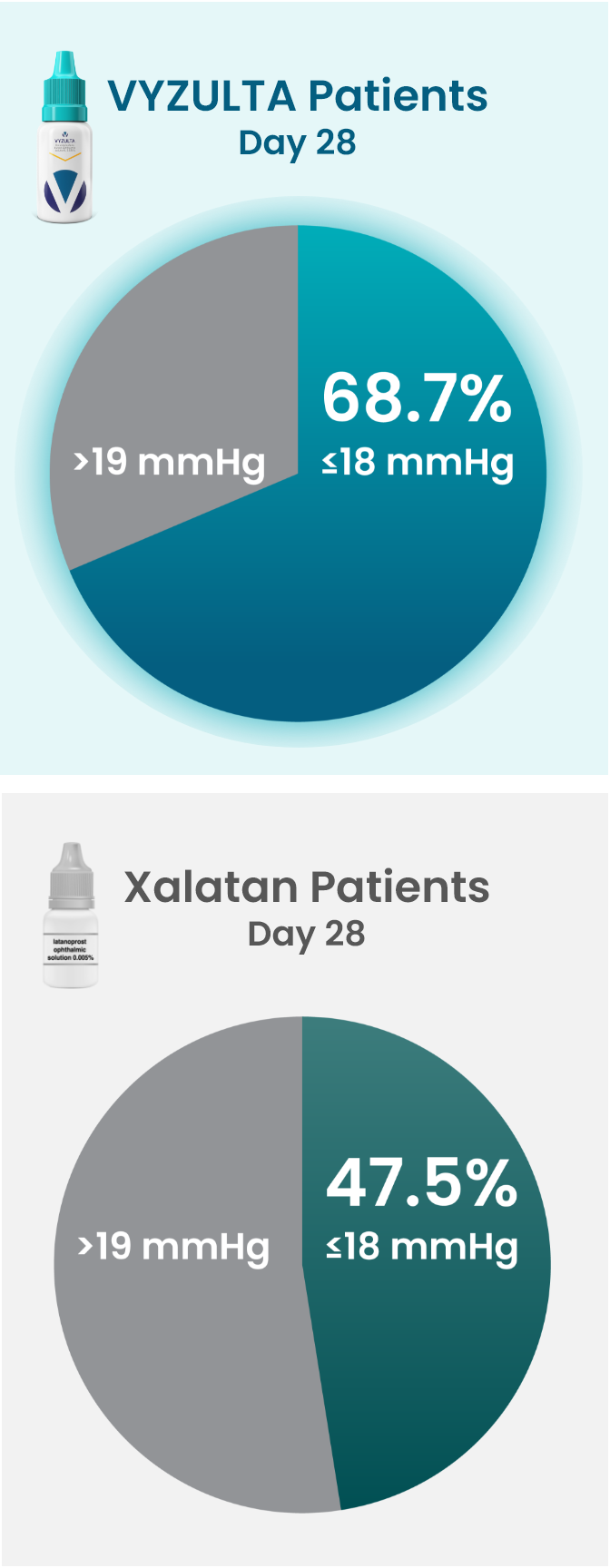
~45%
more patients taking VYZULTA achieved mean diurnal IOP ≤18 mmHg at Day 287
Baseline mean diurnal IOP was 26.01 mmHg and 26.15 mmHg for VYZULTA (n=83) and Xalatan (n=82), respectively.7
The JUPITER study
VYZULTA is approved for use in both high and normal pressure ranges.4,7,9-10
Studies have shown that 30% to 40% of patients with glaucoma have an IOP within the normal range.11
- In a Phase 3, single-arm study of 130 Japanese patients, 74.6% had a baseline IOP of 15 to 21 mmHg, and 92.3% completed at least 364 days of treatment.9,12
- Over 1 year, VYZULTA consistently reduced mean IOP from baseline at all visits.9

mean IOP reduction
from baseline
at Week 529

See what VYZULTA clinical trial results stood out to these optometrists.
Watch ophthalmologists review case study results of a patient switched to VYZULTA.
*Vs 6.6 mmHg-8.0 mmHg for timolol 0.5%.1,2
†Vs 27% and 28% with timolol 0.5% in LUNAR and APOLLO, respectively.3
Sign up
Sign up to receive updates and learn more about VYZULTA.

INDICATION
VYZULTA® (latanoprostene bunod ophthalmic solution), 0.024% is indicated for the reduction of intraocular pressure (IOP) in patients with open-angle glaucoma or ocular hypertension.
IMPORTANT SAFETY INFORMATION
- Increased pigmentation of the iris and periorbital tissue (eyelid) can occur. Iris pigmentation is likely to be permanent
- Gradual changes to eyelashes, including increased length, increased thickness, and number of eyelashes, may occur. These changes are usually reversible upon treatment discontinuation
- Use with caution in patients with a history of intraocular inflammation (iritis/uveitis). VYZULTA should generally not be used in patients with active intraocular inflammation
- Macular edema, including cystoid macular edema, has been reported during treatment with prostaglandin analogs. Use with caution in aphakic patients, in pseudophakic patients with a torn posterior lens capsule, or in patients with known risk factors for macular edema
- There have been reports of bacterial keratitis associated with the use of multiple-dose containers of topical ophthalmic products that were inadvertently contaminated by patients
- Contact lenses should be removed prior to the administration of VYZULTA and may be reinserted 15 minutes after administration
- Most common ocular adverse reactions with incidence ≥2% are conjunctival hyperemia (6%), eye irritation (4%), eye pain (3%), and instillation site pain (2%)
You are encouraged to report negative side effects of prescription drugs to the FDA. Visit www.fda.gov/medwatch or call 1-800-FDA-1088.
Please click here to see full Prescribing Information.
References: 1. Weinreb RN, Scassellati Sforzolini B, Vittitow J, Liebmann J. Latanoprostene bunod 0.024% versus timolol maleate 0.5% in subjects with open-angle glaucoma or ocular hypertension: the APOLLO study. Ophthalmology. 2016;123(5):965-973. 2. Medeiros FA, Martin KR, Peace J, Scassellati Sforzolini B, Vittitow JL, Weinreb RN. Comparison of latanoprostene bunod 0.024% and timolol maleate 0.5% in open-angle glaucoma or ocular hypertension: the LUNAR study. Am J Ophthalmol. 2016;168:250-259. 3. Kaufman PL. Latanoprostene bunod ophthalmic solution 0.024% for IOP lowering in glaucoma and ocular hypertension. Expert Opin Pharmacother. 2017;18(4):433-444. 4. Weinreb RN, Liebmann JM, Martin KR, Kaufman PL, Vittitow JL. Latanoprostene bunod 0.024% in subjects with open-angle glaucoma or ocular hypertension: pooled phase 3 study findings. J Glaucoma. 2018;27(1):7-15. 5. Primary Open-Angle Glaucoma Preferred Practice Pattern. American Academy of Ophthalmology; 2020. 6. Peace JH, Vittitow JL. Latanoprostene bunod ophthalmic solution 0.024% for IOP lowering in glaucoma: responder rates in phase 3 studies. Poster presented at: American Academy of Ophthalmology Meeting; October 15-18, 2016; Chicago, Illinois. 7. Weinreb RN, Ong T, Scassellati Sforzolini B, Vittitow JL, Singh K, Kaufman PL; VOYAGER Study Group. A randomised, controlled comparison of latanoprostene bunod and latanoprost 0.005% in the treatment of ocular hypertension and open-angle glaucoma: the VOYAGER study. Br J Ophthalmol. 2015;99(6):738-745. 8. Data on file. Bausch & Lomb Inc. 9. Kawase K, Vittitow JL, Weinreb RN, Araie M; JUPITER Study Group. Long-term safety and efficacy of latanoprostene bunod 0.024% in Japanese subjects with open-angle glaucoma or ocular hypertension: the JUPITER study. Adv Ther. 2016;33(9):1612-1627. 10. VYZULTA. Prescribing Information. Bausch & Lomb Inc. 11. Song BJ, Caprioli J. New directions in the treatment of normal tension glaucoma. Indian J Ophthalmol. 2014;62(5):529-37. 12. Application Number: 207795Orig1s000. Statistical Review(s). Food & Drug Administration; 2015.

INDICATION
VYZULTA® (latanoprostene bunod ophthalmic solution), 0.024% is indicated for the reduction of intraocular pressure (IOP) in patients with open-angle glaucoma or ocular hypertension.
IMPORTANT SAFETY INFORMATION
- Increased pigmentation of the iris and periorbital tissue (eyelid) can occur. Iris pigmentation is likely to be permanent
